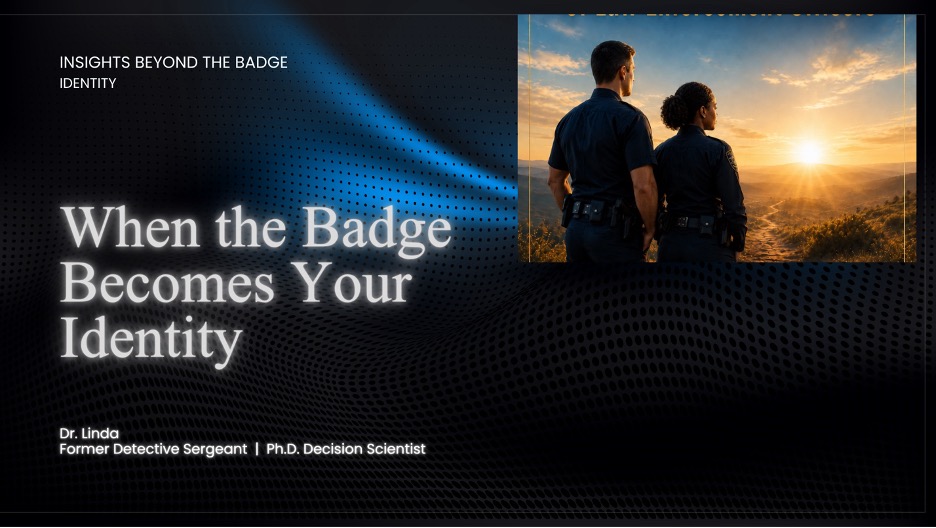
At first, the badge is something you put on.
You learn the job. You develop judgment. You become more observant. You learn how to make decisions when information is incomplete and consequences are real. You earn responsibility, experience, credibility, perhaps rank.
And somewhere along the way, something else can happen.
The job can become more than what you do.
It can begin answering the question of who you are.
That distinction matters.
There is nothing wrong with being proud to be a police officer. There is nothing wrong with feeling deeply connected to a profession built around service, responsibility, sacrifice, and protecting other people.
The concern begins when the badge becomes the primary place from which identity, purpose, belonging, confidence, and direction are drawn.
Because eventually every officer has to answer a question the profession rarely requires you to confront:
Who am I when I am not being a police officer?
When a Career Becomes More Than a Career
Law enforcement is not an ordinary occupation.
You do not simply learn policies and procedures. You learn how to observe differently, assess risk differently, communicate differently, and make decisions differently.
The profession also creates powerful forms of belonging. There is shared language. Shared experience. Shared responsibility. Shared humor. Shared understanding of situations that can be difficult to explain to someone who has never done the job.
Research on police identity supports the idea that policing culture can play a meaningful role in how officers construct their professional identities. Recent qualitative research has examined how occupational culture, language, norms, and expectations contribute to what it means to see oneself as a police officer, as well as the tension that can develop between professional and personal identity.
None of that means police identity is inherently unhealthy.
A strong professional identity can create commitment, competence, belonging, pride, and purpose.
The issue is not having a police identity.
The issue is having too little identity outside of it.
What May Really Be Happening
Identity rarely disappears all at once.
It narrows.
Your closest relationships may increasingly be people from the job.
Your conversations may increasingly revolve around the job.
Your schedule is built around the job.
Your sleep is influenced by the job.
Your social life accommodates the job.
Your family adapts to the job.
Your future plans are calculated around the job.
Even when you are technically off duty, the role can remain mentally present.
After enough years, it can become difficult to separate the capable professional you had to become from the larger person you still are.
That is an important distinction because the qualities that make you effective in law enforcement are only part of your identity.
Detective is a role.
Sergeant is a role.
Commander is a role.
Officer is a role.
They can be meaningful roles. Honorable roles. Roles you have earned.
But they are still roles.
A title can describe your responsibility without defining your entire identity.
Why This Can Be Difficult to See
One reason identity can become so closely tied to policing is that the profession continually reinforces the role.
You are evaluated through it.
People recognize you through it.
Colleagues depend on you through it.
Your department gives you responsibility through it.
Your family may organize significant parts of life around it.
People outside law enforcement may even introduce you by it.
“You should talk to Linda. She’s a detective.”
“He’s a cop.”
“She’s a sergeant.”
Over time, repetition matters.
The role becomes familiar, reinforced, socially meaningful, and deeply practiced.
That can make professional identity exceptionally strong.
And when one identity receives years of attention while other parts of life receive whatever energy remains, imbalance can develop quietly.
This is one reason I believe the conversation about officer well-being has to extend beyond stress alone.
Stress matters. Current federal officer-wellness initiatives appropriately address areas such as stress reduction, family resources, peer support, and broader mental and emotional wellness.
But there is another question worth asking:
What happens to the person when the profession becomes the dominant organizing force in his or her life?
That question is about identity.
And identity influences far more than how you feel about your career.
Why Identity Outside the Badge Matters
A broader identity gives you more than interests outside of work.
It gives you additional places from which to draw meaning.
You may be an officer.
You may also be a spouse or partner.
A parent.
A friend.
A mentor.
A learner.
A person of faith.
A business owner.
A volunteer.
An athlete.
A traveler.
A musician.
A teacher.
A neighbor.
Someone building a future that has nothing to do with rank, assignment, or department politics.
Those identities do not compete with the badge.
They keep the badge in proportion.
This is the distinction I want officers to understand:
The goal is not to become less committed to the badge. The goal is to make sure commitment to the badge does not require losing sight of the person wearing it.
When Professional Strength Starts Running Your Personal Life
Law enforcement develops strengths.
Decisiveness.
Awareness.
Control.
Independence.
Problem-solving.
Emotional discipline.
Responsibility.
The ability to act when other people hesitate.
These qualities can be enormously valuable.
But a strength developed for one environment does not automatically belong in every environment.
Command presence may be useful during a difficult call.
It may be less useful during a disagreement with your spouse.
Constant assessment may help keep you safe on duty.
It may make it difficult to relax when everyone else at home has already settled down.
Self-reliance may allow you to function in difficult circumstances.
It may also make it harder to tell someone close to you that you do not have an answer.
The goal is not to eliminate these qualities.
It is to develop the ability to decide when they serve you and when they do not.
That is personal alignment.
A Practical Way to Evaluate Where You Are
You do not need a major crisis to examine your identity.
Start with a few direct questions.
1. How do you describe yourself without mentioning your occupation?
If the answer is surprisingly difficult, pay attention to that.
2. What areas of your life receive your best energy?
Not the energy left over after the shift, overtime, court, callbacks, and responsibilities.
Your best energy.
Where does it go?
3. What relationships would still define your life if your law enforcement career ended tomorrow?
And are you investing in those relationships now?
4. What are you actively building that does not depend on the badge?
Think beyond hobbies.
What are you developing intellectually, relationally, financially, spiritually, socially, or personally that belongs entirely to you?
5. When you picture your future, can you see the person—or only the career?
This may be the most important question.
Because eventually there will be a life after the assignment.
After the rank.
After the department.
After the badge.
The strongest time to build that life is not after everything else disappears.
It is while you still have the opportunity to build it intentionally.
Strengthening Identity Does Not Mean Walking Away From the Job
This conversation is not about encouraging officers to leave policing.
It is about helping officers stay connected to themselves while they are in it.
You can love the profession and still develop a life beyond it.
You can take pride in your service and still protect your relationships.
You can pursue promotion and still build interests that have nothing to do with your department.
You can remain committed to your career while asking whether the life surrounding that career reflects the person you want to become.
That is not disloyalty to the profession.
It is intentionality about your life.
What Progress Can Look Like
A stronger identity outside the badge does not require reinventing yourself.
It can begin much more practically.
You start noticing where the job has become too dominant.
You become clearer about your values outside the profession.
You invest differently in important relationships.
You make decisions based not only on what advances your career, but also on what supports the life you ultimately want.
You strengthen parts of yourself that have received less attention.
And you begin answering a different question.
Not simply:
What kind of officer do I want to be?
But also:
What kind of person and life am I building while I am becoming that officer?
That is the larger work.
Why I Built Thrive Beyond the Badge™
I spent 17 years in law enforcement and finished my career as a Detective Sergeant. I understand how deeply the profession can shape the person doing the work.
My work today as a Ph.D. Decision Scientist and Identity Strategist focuses on helping law enforcement professionals look deliberately at identity, relationships, clarity, direction, and the life they are building beyond the demands of the role.
Thrive Beyond the Badge™ exists because officers spend years being trained to perform the job.
They deserve a structured way to strengthen the person performing it.
Ready to Look at What Comes Next?
If the job has begun shaping more of your identity, relationships, or future direction than you intended, you do not have to wait for a major transition or crisis to address it.
Thrive Beyond the Badge™ provides private, structured, research-informed guidance designed specifically for law enforcement professionals who want greater clarity about where they are and what they want to build next.
Apply to work with Dr. Linda. Every application is personally reviewed to determine whether Thrive Beyond the Badge™ is the right fit for where you are.